Read the
Picture
An open collection
Japan, Edo period (1615–1868) · Other

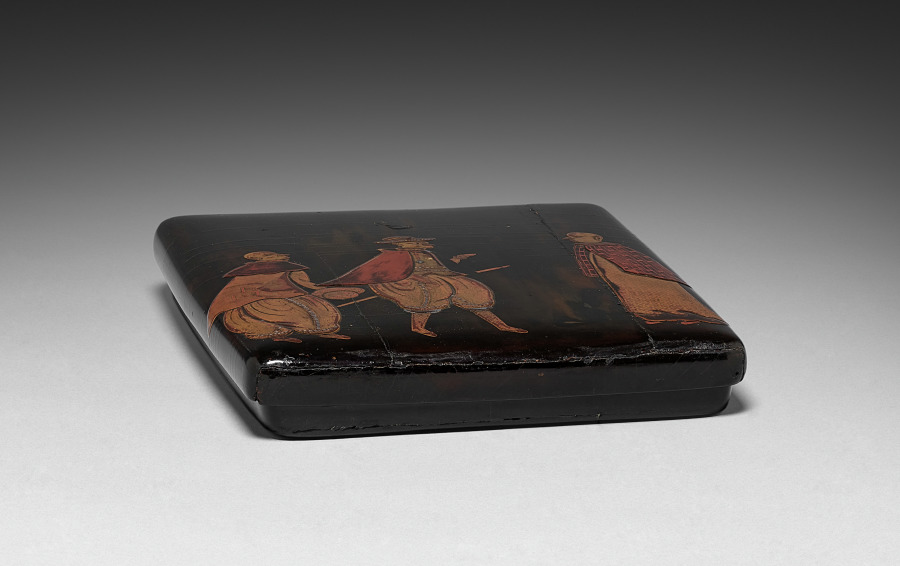
Writing Box (Suzuribako) with Europeans

Maker unrecorded · 1800s

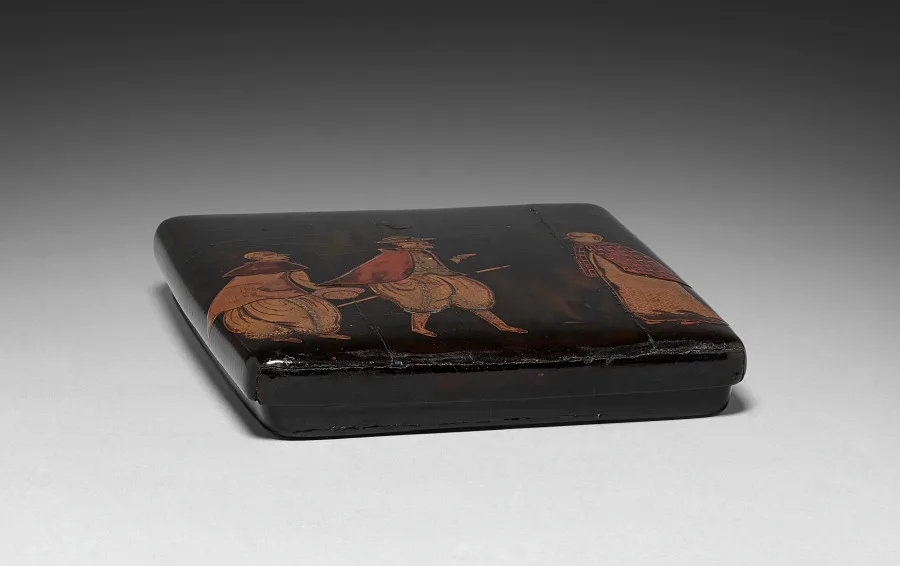
A low black lacquer writing box is shown at an angle. Three reddish-gold figures occupy its lid: two wear broad rounded trousers and hats, while a third wears a long robe. Fine details glint against the dark ground. The rounded corners, fitted lid, and seam around the sides make the object’s container form clear.
100%

Drag to move · Pinch or +/− to zoom · Arrow keys to pan · 0 to reset

The Cleveland Museum of Art · 1969.59 · Image: CC0Museum image ↗
A little context

Clothing distinguishes traders from a priest on a writing box made long after the first Portuguese ships reached Japan.

The three figures are small, but their clothes make the scene legible. Two wear balloon-shaped trousers, while the figure facing them wears a long robe. The museum identifies Portuguese traders and a Jesuit priest. Their contrasting silhouettes offer a useful example of how dress can serve as a historical clue when supported by a reliable record.

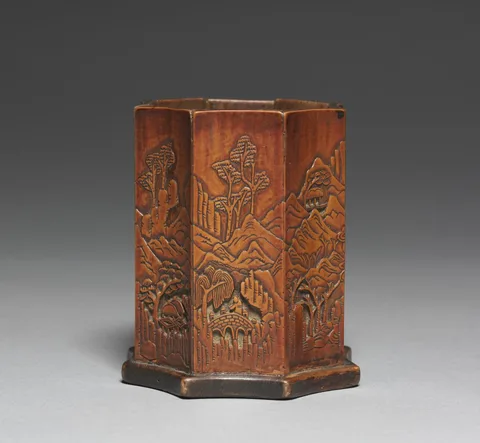
The box dates to the nineteenth century, centuries after Portuguese ships first reached Japan in the 1540s. The museum explains that images first used to record the appearance of foreigners continued as decoration on later objects. This is therefore not an eyewitness picture of the first encounter. Its black lacquer, gold decoration, silver inlay, and red lacquer turn inherited imagery into a finely worked surface for a writing accessory. Compare the Korean Brush Holder to see how objects associated with literacy could carry very different kinds of pictorial worlds: historical outsiders on one, a landscape ideal on the other.

A careful reading

The nineteenth-century box preserves imagery of earlier encounters rather than documenting a contemporary arrival. The museum identifies the figures by clothing; the image does not supply individual names or a specific conversation.

Try your eye

Which visible contrast supports the museum’s distinction between traders and a priest?

Where this reading begins

  • Writing Box (Suzuribako) with Europeans — collection record — The Cleveland Museum of Art. Supports identification, dating, materials, authorship qualifications and contextual interpretation; close-looking observations describe the individually inspected museum photograph. Museum record updated 2026-05-29; accessed 2026-11-13.

Our observations describe the supplied museum photograph. Historical identifications and context follow the cited collection record; interpretive limits are stated above. This is an independent guide, not a museum endorsement.

Image rights & attribution

Writing Box (Suzuribako) with Europeans (蒔絵南蛮人図硯箱), 1800s. Japan, Edo period (1615–1868). Lacquered wood with gold maki-e, silver inlay and red lacquer on black ground; 23 x 20.2 cm (9 1/16 x 7 15/16 in.). The Cleveland Museum of Art, Andrew R. and Martha Holden Jennings Fund, 1969.59

Individual API record marked CC0; checked 2026-11-13. CC0 1.0 dedication. Record date: 2026-05-29 07:26:27.840000. Web JPEG downloaded unchanged; responsive WebP and zoom derivatives resized and recompressed; numbered annotation overlay separate from image.