Read the
Picture
An open collection
France · Sculpture

The Thinker

Auguste Rodin (French, 1840–1917) · c. 1880

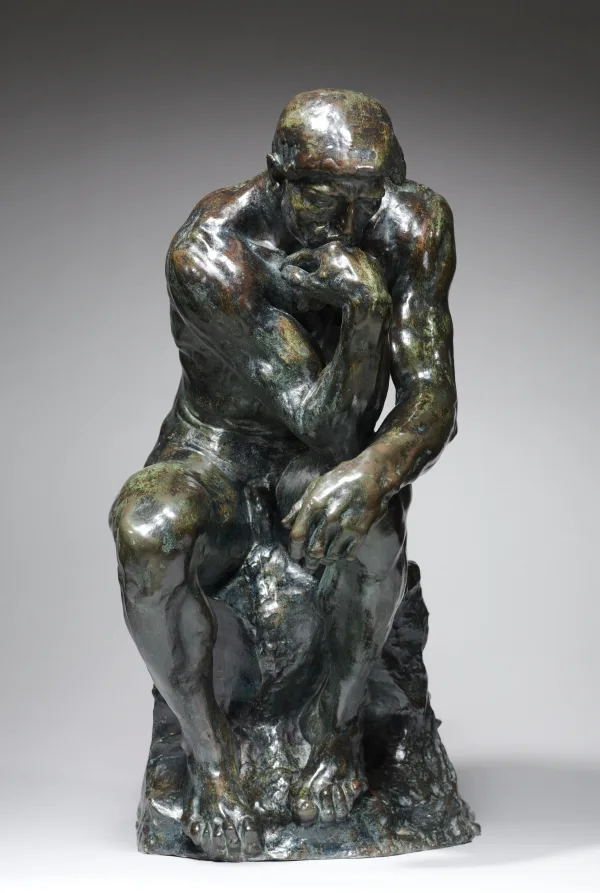
A dark bronze nude man sits on a rough base against a gray background, leaning forward with his head lowered onto one hand. His other arm crosses toward a bent knee. Strongly modeled shoulders, forearms, thighs, and toes catch bright highlights, while recesses between limbs remain deeply shadowed.
100%

Drag to move · Pinch or +/− to zoom · Arrow keys to pan · 0 to reset

The Cleveland Museum of Art · 1979.138 · Image: CC0Museum image ↗
A little context

Thought becomes a whole-body action: look at the crossed limbs and tense surfaces, not only the hand beneath the chin.

The familiar hand beneath the chin is only one part of this pose. The head drops, the shoulders curl forward, and the arms cross the body’s central axis. Feet and bent legs hold the seated figure in a compact, tense arrangement. Rodin makes thinking visible by involving the entire body, even though no physical labor or external action is being performed.

The figure began as part of The Gates of Hell, a large sculptural doorway inspired by Dante’s account of the underworld. The museum explains that Rodin initially conceived it in relation to Dante looking down on the suffering figures below. He subsequently produced independent versions, including this bronze at the original smaller scale. Seen alone, the figure can invite broader ideas about thought and creative effort, but its earlier narrative setting remains useful context. The photograph also has limits: its highlights reveal some forms while a single frontal viewpoint conceals others that would change as you walked around the sculpture.

A careful reading

This is one version of a sculpture made in different sizes and casts. The photograph shows a single view, and its bright highlights depend on lighting as well as on the bronze surface.
Try your eye

Which observation best supports the idea that thought is shown through the whole body?

Where this reading begins

  • The Thinker — collection record — The Cleveland Museum of Art. Explains the figure’s origin as Dante above The Gates of Hell, its independent versions and original smaller scale, and the museum’s interpretation of muscular tension as mental activity. 2026-11-07; accessed 2026-11-16.

Our observations describe the supplied museum photograph. Historical identifications and context follow the cited collection record; interpretive limits are stated above. This is an independent guide, not a museum endorsement.

Image rights & attribution

The Thinker, c. 1880. Auguste Rodin (French, 1840–1917). Bronze; overall: 70.8 x 34.9 x 59.7 cm (27 7/8 x 13 3/4 x 23 1/2 in.). The Cleveland Museum of Art, Gift of Alexandre P. Rosenberg, 1979.138

Individual API record marked CC0; checked 2026-11-13. CC0 1.0 dedication. Record date: 2026-11-07 15:30:13.500000. Web JPEG downloaded unchanged; responsive WebP and zoom derivatives resized and recompressed; numbered annotation overlay separate from image.