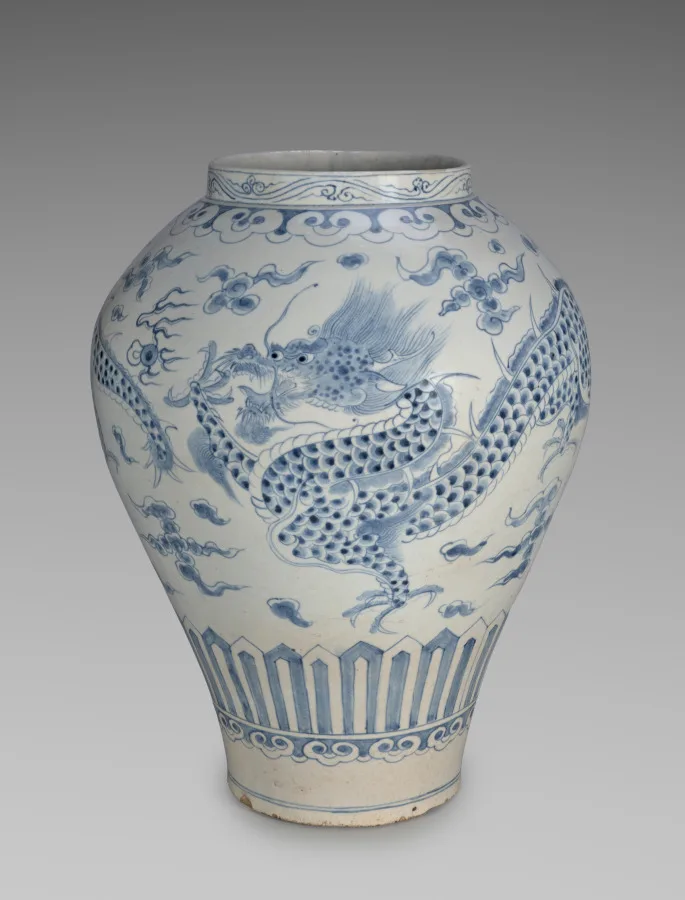
A blue dragon coils around a tall white jar, linking a moving painted body with a vessel intended for a royal setting.
The dragon’s body is a route around the vessel. Its head turns to one side while a long scaled curve crosses the white surface, then continues beyond the visible face. Clouds fill the spaces around it, keeping the creature in motion rather than placing it on ordinary ground. The museum identifies the dragon as pursuing a flaming wish-granting jewel.
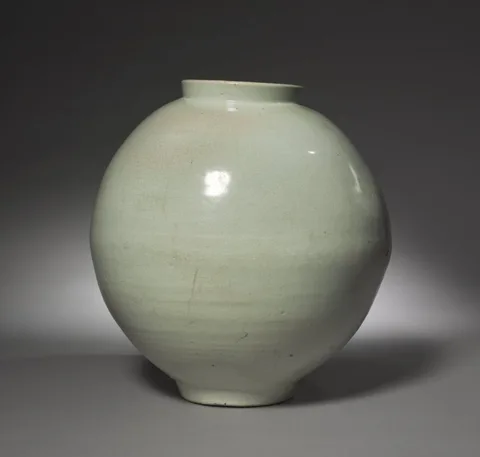
In the Joseon court, dragons were closely associated with royal authority. The museum distinguishes taller dragon jars, used for flowers, from shorter types used for wine. That distinction makes shape important alongside imagery: the dragon alone does not tell us everything about the object’s use. Compare the plain Joseon White Jar, where an unfigured surface directs attention almost entirely to proportion and glaze. Here, blue underglaze painting creates a powerful additional presence. The photograph shows only one side, so the complete route of the dragon and every cloud cannot be reconstructed from this view alone.
The museum identifies the royal vessel type and its flower-holding use, not a specific ceremony or individual owner. Dragon symbolism is discussed within this Korean court setting, not as a universal meaning across all cultures.