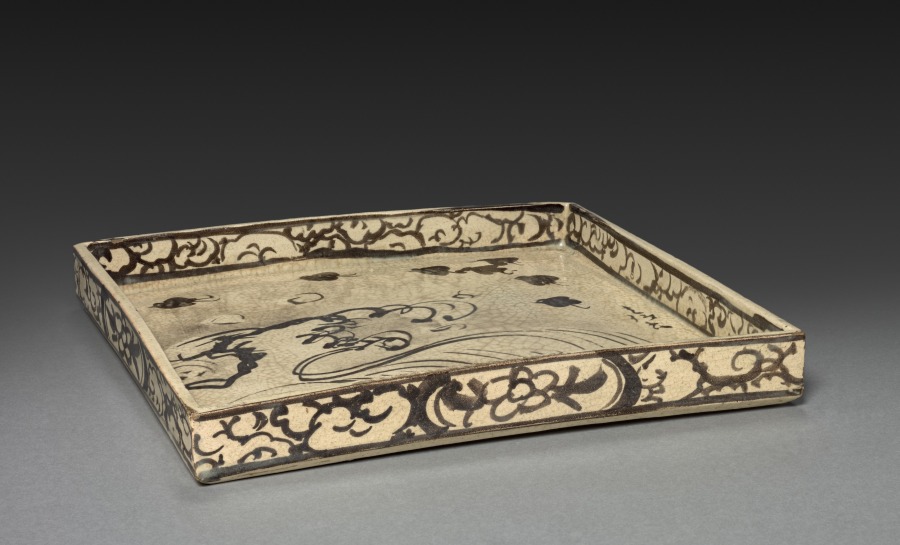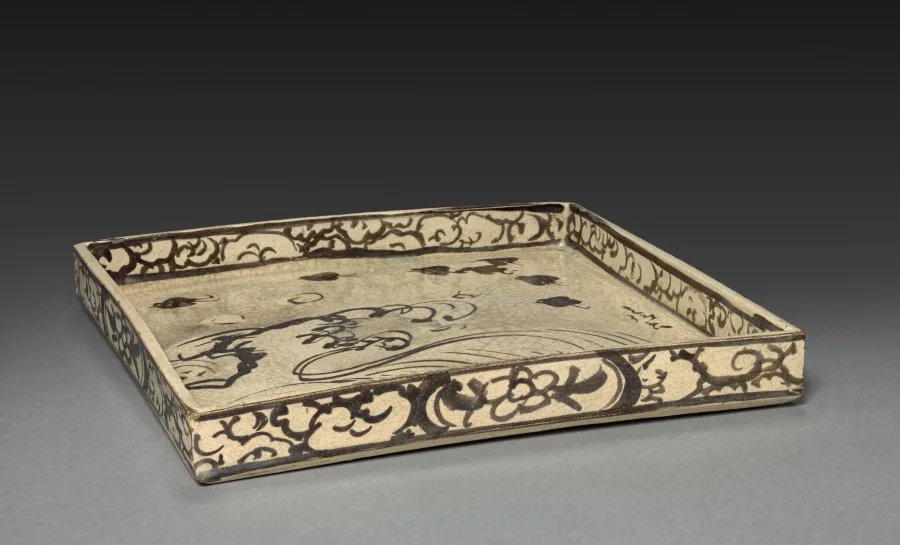
A small serving dish records a collaboration: one brother shaped and fired it while another drew birds above curling waves.
The low walls make this a shallow serving surface rather than a deep container. Small dark birds cross the open interior above broad curling waves, while a denser border encloses the scene. The museum identifies the birds as plovers and connects the dish with a set used for serving tea cakes. A familiar literary motif therefore became part of a practical encounter with food.
The object records a division of artistic labour. Ogata Kenzan formed the dish, Kōrin drew the iron-oxide design, and Kenzan glazed and fired it. The museum’s detailed record tentatively assigns the wall ornament to a kiln assistant. Kōrin signed beside his picture, while Kenzan’s signature is on the back. Compare Kōrin’s Plum Tree: the same painter worked on silk and on a ceramic surface made with others. The two reproductions can be read as images, but the originals differ in material, handling and use.
The back signature is documented by the museum but not visible in this photograph. The dish’s literary associations do not identify a particular poem being recited at a specific tea gathering.
Which description best represents how the dish was made?
Practise looking at Square Dish with Design of Plovers over Waves →