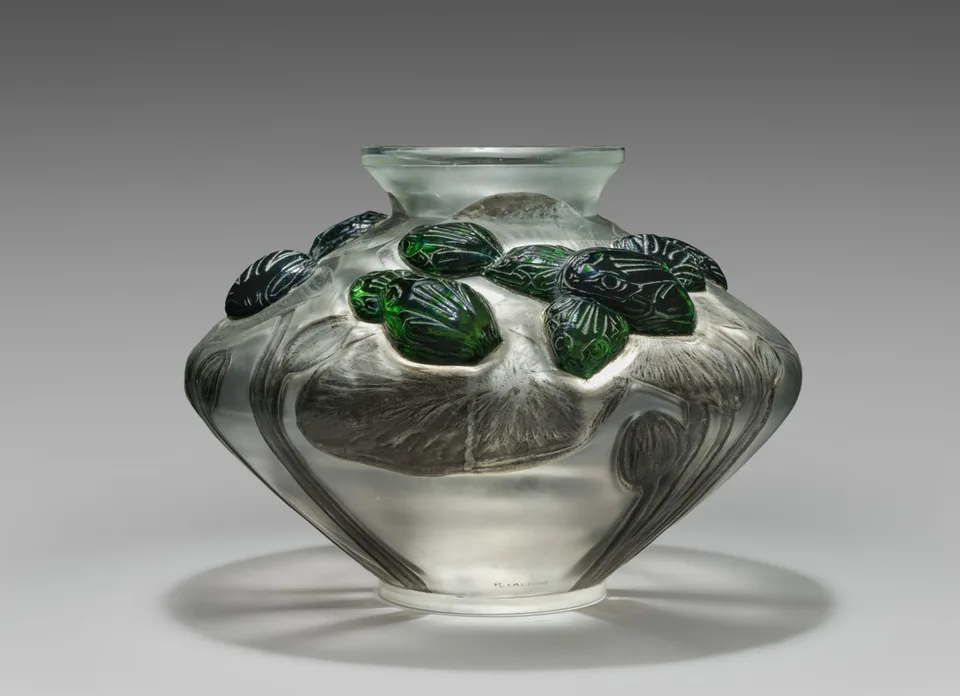
Green frogs perch on a glass shoulder that turns a vessel’s curve into the suggestion of a pond surface.
The frogs gather around the vase’s widest area, where the curved shoulder gives them small apparent platforms. Their dark green bodies contrast strongly with the cloudy clear glass beneath. Broad pads and flowing plant forms continue downward, partly obscuring and partly revealing the vessel’s interior. Light seems to pass through a small watery environment rather than an undecorated container.
The museum places this vase among Lalique’s early experiments in artistic glass, dated 1909–12. It identifies applied, cast, and molded techniques used to evoke a murky swamp, a natural motif associated with Art Nouveau. Small sheets of metal foil behind the applied frogs reflect their dark green tint toward the viewer. The effect therefore comes from more than differently colored glass: relief, reflective backing, transparency, and the vessel’s curvature all help suggest a watery setting.
The swamp effect is an artistic evocation, not a miniature biological habitat. The photograph’s lighting strongly affects transparency, and a single view cannot show every frog or relief detail.
How does the vase suggest a watery habitat?
Practise looking at Frogs and Lily Pads (Grenouilles et Nénuphars) Vase →