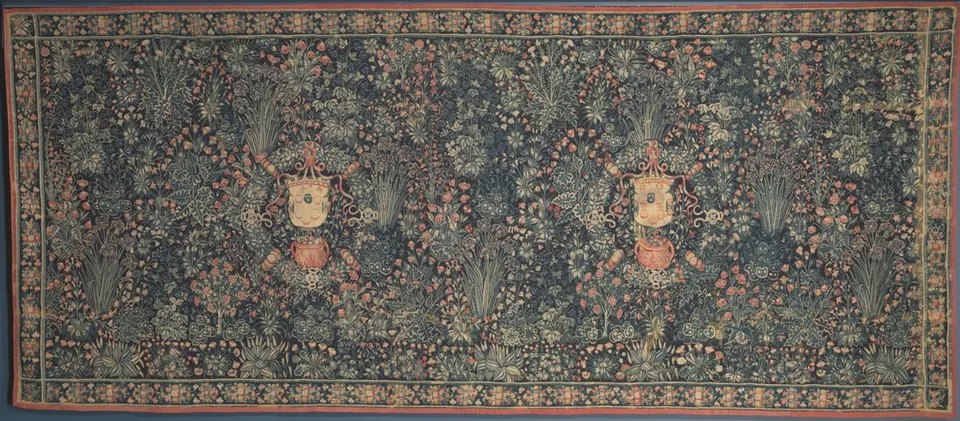
Two coats of arms interrupt a field of flowers, but the heraldry now visible was not part of the original arrangement.
The eye can wander among the plants before finding either heraldic display. Tall narrow leaves, small rounded blossoms, and branching stems fill the dark ground with varied scales of growth. A thin border encloses the whole without turning the flowers into a deep landscape. The two heraldic interruptions establish larger focal points within an otherwise distributed field.
Millefleurs means “a thousand flowers,” a name for a tapestry pattern fashionable from the mid-fifteenth century. The museum cautions that such flowers need not all carry symbolic meanings, even though some could suggest religion, courtship, or morals. This example also contains a material revision: its original coat of arms was replaced by that of the Medici family. The current heraldry therefore cannot simply identify the first commissioner. The tapestry records both an ornamental system and an altered claim of association, making later intervention part of what we see.
The Medici arms are replacements, not secure evidence of the original commission. Individual flowers should not automatically be assigned symbolic meanings, since the museum explicitly allows non-symbolic millefleurs decoration.
Why can the Medici arms not identify the original patron securely?
Practise looking at Millefleurs Tapestry with Medici Coat of Arms →