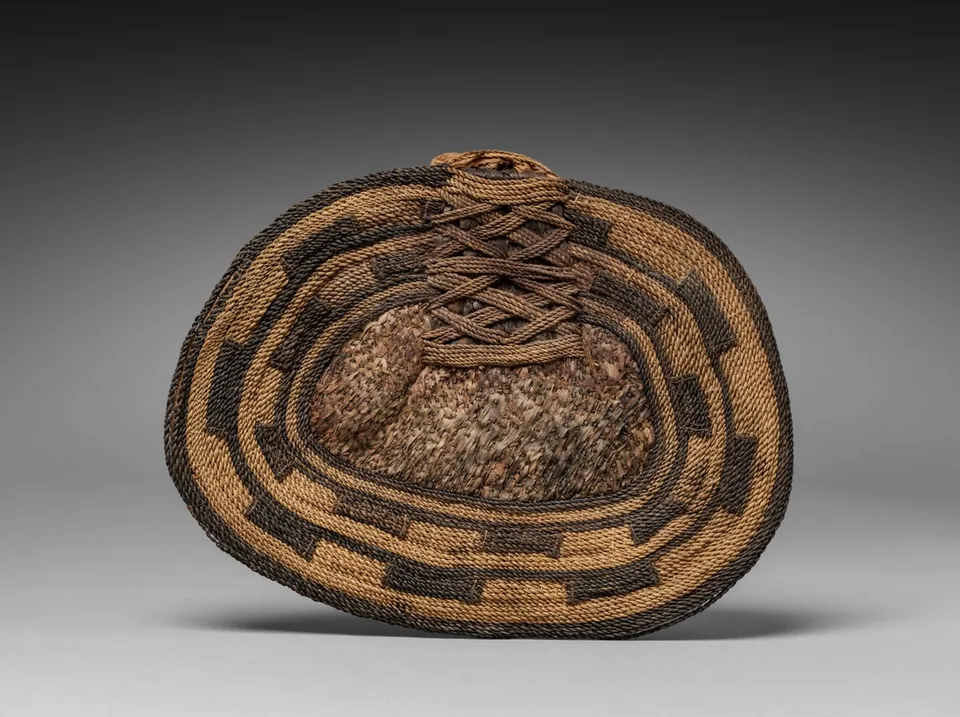
A boldly patterned oval was designed to move with a body and become a cushion when its wearer sat down.
Mangbetu aristocratic women made back skirts or sitting pads called egbe, with negbe as the singular form. The object combined clothing, decoration and physical comfort. Tied to a girdle over a skirt, its curved inner portion rested against the lower back. Flexible, thickly woven fibres could bend under the wearer when she sat, while the outward-facing decorated portion displayed geometric designs when she stood.
The broad oval and its repeated dark steps are easier to understand if we imagine these changes of position. The lacing near the top connects separate areas of the construction; the rougher centre contrasts with the orderly patterned border. The museum records Paul Travis’s purchase in Ekibondo in 1928. It also describes Mangbetu encouragement of sales to foreigners during this period, when makers actively shaped how outsiders encountered their culture. A collected garment is therefore evidence of both local fashion and an exchange with visitors.
The photograph fixes a flexible garment upright. Its exact appearance on a particular wearer is unrecorded, and purchase by a foreign visitor does not establish that it was previously worn.