Read the
Picture
An open collection
Southern Africa, Zimbabwe or Mozambique, Shona-style blacksmith-carver · Sculpture

Headrest

Maker unrecorded · c. 1910

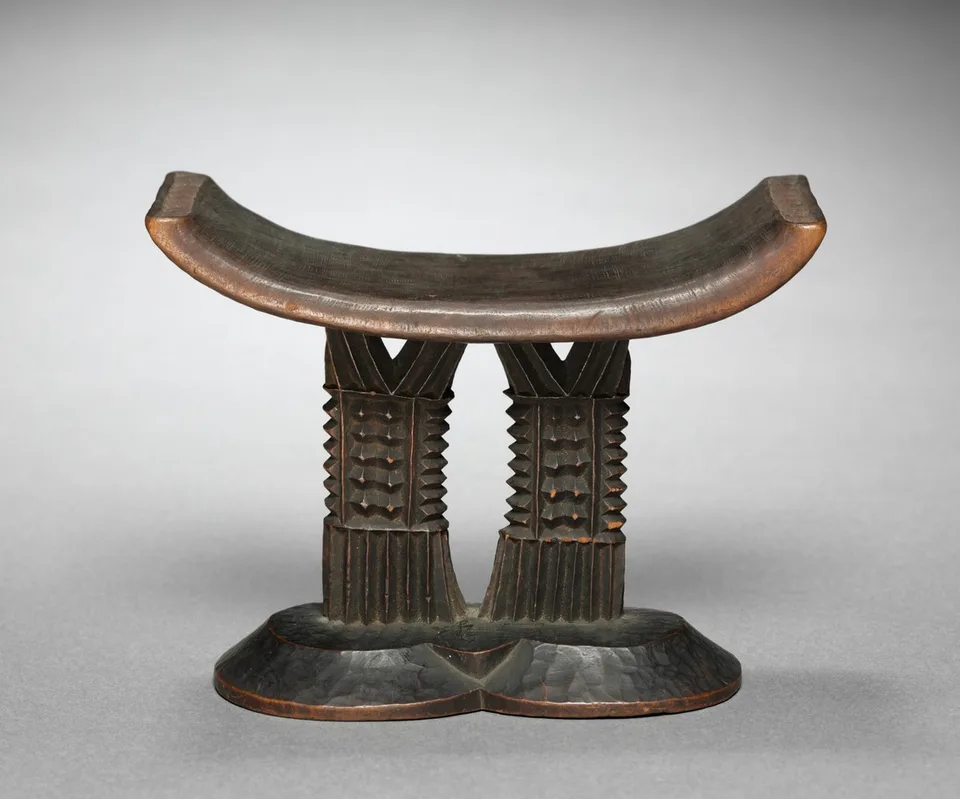
A dark wooden headrest has a long concave top with raised ends. Two upright supports rise from a broad double-lobed base. Each support is carved with vertical grooves and rows of small projecting points. The upper surface has a smooth sheen, while the lower carved areas remain visibly textured.
100%

Drag to move · Pinch or +/− to zoom · Arrow keys to pan · 0 to reset

The Cleveland Museum of Art · 1921.1548 · Image: CC0Museum image ↗
A little context

The most polished wood lies where a resting head would touch, above supports that preserve a much sharper carved texture.

A headrest supported the neck or chin while protecting an elaborate hairstyle. The museum connects this Shona example with men’s braids and explains that repeated contact with hair and hairdressing substances darkened its upper surface. The finish is therefore useful evidence: the smoothly worked contact area differs from the incised and projecting decoration beneath it. This distinction joins bodily comfort to the sculptor’s handling of the wood.

The two uprights create a strong open gap under the curved top. Their repeated points catch light differently from the broad polished rim and double-lobed foot. Recent research cited by the museum proposes that projections on Shona headrests refer to women’s scarification and that such objects carried female symbolism for mature male owners. That interpretation needs its historical context. The headrest’s close association with an individual could also make it an heirloom or burial possession, rather than simply interchangeable furniture.

A careful reading

The museum presents the female symbolism as a research interpretation. Surface wear supports bodily contact, but cannot identify this headrest’s particular owner or establish its complete use history.
Try your eye

Where is the wood most smoothly finished for bodily contact?

Where this reading begins

  • Headrest: collection record — The Cleveland Museum of Art. Identification, qualified cultural and maker attribution, materials, object-specific historical context, provenance and stated uncertainties; photograph independently inspected for visual observations. Museum record updated 2026-05-29; accessed 2026-11-14.

Our observations describe the supplied museum photograph. Historical identifications and context follow the cited collection record; interpretive limits are stated above. This is an independent guide, not a museum endorsement.

Image rights & attribution

Headrest, c. 1910. Southern Africa, Zimbabwe or Mozambique, Shona-style blacksmith-carver. Wood; overall: 13.4 x 17.8 cm (5 1/4 x 7 in.). The Cleveland Museum of Art, Gift of W. A. Price, 1921.1548

Individual API record marked CC0; checked 2026-11-14. CC0 1.0 dedication. Record date: 2026-05-29 05:33:34.432000. Museum print JPEG preserved unchanged in local originals; overview JPEG resized and recompressed from that same full frame; responsive WebP and zoom derivatives resized and recompressed; numbered annotation overlay separate from image.