Read the
Picture
An open collection
South Italian, Paestan · Ceramic

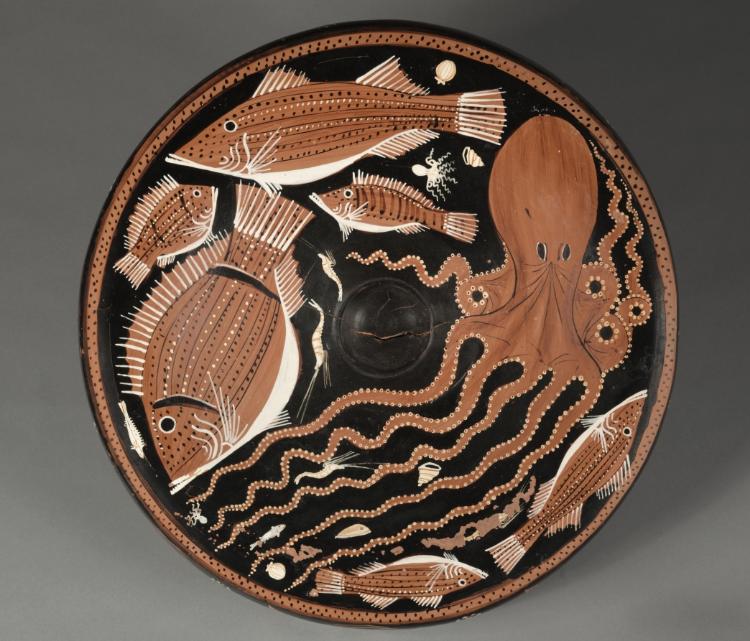
Red-Figure Fish Plate: Octopi, Mullet, Bream, Shellfish

Attributed to Asteas/Python Workshop (South Italian, Paestan, active c. 360–320 BCE) · c. 340–330 BCE

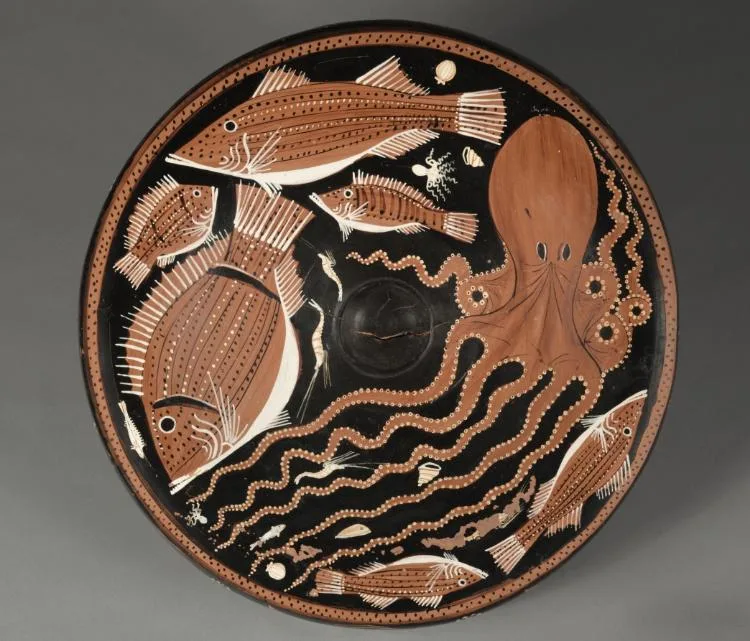
A circular ceramic plate is viewed from above. Orange-red fish, shellfish and a large octopus fill a glossy black field around a dark central depression. The octopus’s arms curve through spaces between the fish. Pale lines mark fins, scales and suckers, and a narrow patterned border runs around the rim.
100%

Drag to move · Pinch or +/− to zoom · Arrow keys to pan · 0 to reset

The Cleveland Museum of Art · 1985.50 · Image: CC0Museum image ↗
A little context

An octopus threads its arms between fish while the plate’s central well quietly reminds us that this image also served food.

Let your eye follow one of the octopus's long arms. It curls between fish and smaller sea creatures, filling spaces that a rigid pattern might leave empty. The painter has balanced recognizable animals with the round shape of the plate. The central depression interrupts the picture, but the surrounding creatures make that interruption part of its design.

Fish plates became especially popular in southern Italy and Sicily during the fourth century BCE. This large, elaborate example is attributed to the workshop of Asteas and Python at Paestum. The museum identifies several Mediterranean creatures, including mullet, bream and octopi. White details sharpen the fins, eyes and suction cups against the dark surface. The small well in the middle could collect juices or hold a dipping liquid, connecting the represented seafood with the practical use of the dish. Decoration and function are unusually easy to read together here, without needing to invent a hidden symbolic meaning for every fish.

A careful reading

The museum identifies marine species, but the arrangement is a designed picture rather than a survey of an underwater habitat. A useful serving form does not establish the exact meal once placed on this particular plate.

Try your eye

Which feature most directly connects the decoration to the plate’s possible practical use?

Where this reading begins

Our observations describe the supplied museum photograph. Historical identifications and context follow the cited collection record; interpretive limits are stated above. This is an independent guide, not a museum endorsement.

Image rights & attribution

Red-Figure Fish Plate: Octopi, Mullet, Bream, Shellfish, c. 340–330 BCE. Attributed to Asteas/Python Workshop (South Italian, Paestan, active c. 360–320 BCE). Ceramic; diameter: 38.3 cm (15 1/16 in.); overall: 7.9 cm (3 1/8 in.); diameter of foot: 16 cm (6 5/16 in.). The Cleveland Museum of Art, Leonard C. Hanna Jr. Fund, 1985.50

Individual API record marked CC0; checked 2026-11-13. CC0 1.0 dedication. Record date: 2026-05-29 07:53:57.148000. Web JPEG downloaded unchanged; responsive WebP and zoom derivatives resized and recompressed; numbered annotation overlay separate from image.