A direct gaze and simplified body challenge easy assumptions about ideal beauty—and the question mark in the title still matters.
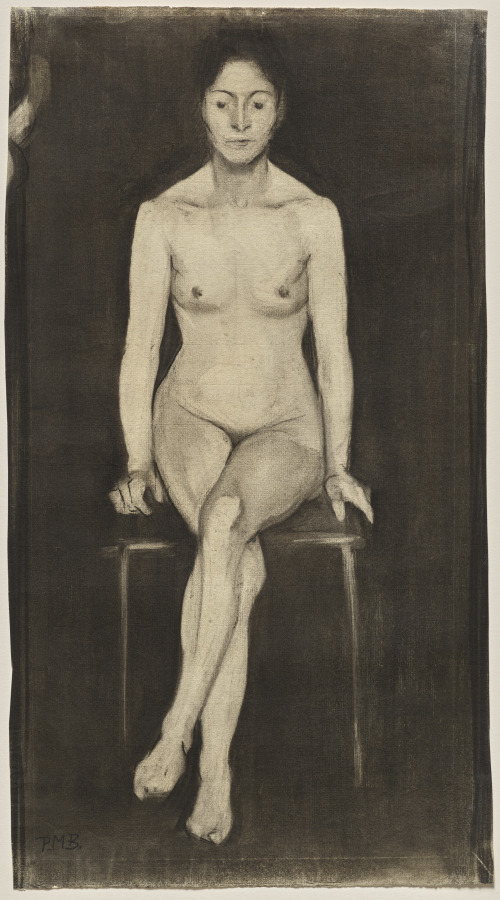
The woman faces us with little surrounding distraction. The chair, crossed legs, and hands beside the hips establish a stable seated pose, while the dark field presses the pale body forward. Modersohn-Becker reduces anatomy to broad connected areas rather than describing every surface equally. The direct gaze is one of the most insistent features, yet it does not independently tell us who the sitter is.
The museum calls the work a likely self-portrait, preserving uncertainty in the title. It also describes charcoal being blended and erased to produce the flattened forms. Look at the body’s broad light areas and then at the more concentrated dark boundary: drawing involves removing and softening material as well as adding it. The image offers a different account of the nude from a smoothly perfected classical figure. Its emotional or spiritual implications are readings of these choices, not visible statements of exactly what the sitter or artist felt.
The self-portrait identification is probable rather than certain. A direct gaze does not prove self-representation, and simplified anatomy should not be treated as a diagnosis of either the sitter’s body or the artist’s mental state.