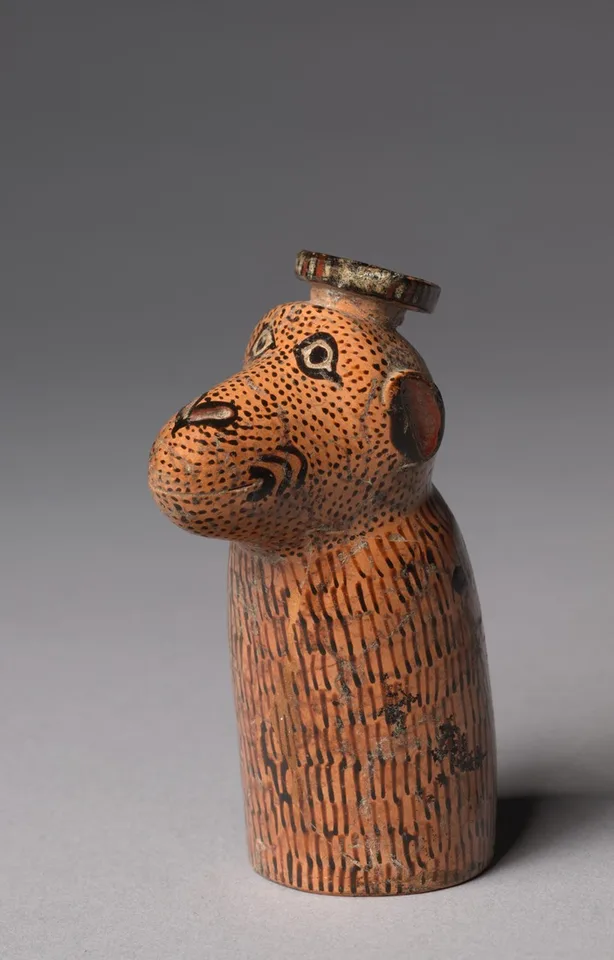
A tiny mouth above a monkey’s head reveals a perfume flask, while dots and long strokes give its clay body an animal surface.
The museum describes this flask as a container for perfume or oil taken to communal baths. A cord allowed it to hang from the wrist, and its owner could apply the contents after bathing. Although monkey-shaped flasks circulated widely around the Mediterranean and Egypt, this one was probably made in a Greek settlement on the western coast of Asia Minor. The attribution remains East Greek, probably Milesian, rather than a certain named workshop.
The animal image emerges through a few concentrated features. A projecting muzzle, circular ear and strongly outlined eyes turn the upper part into a face, while small dots suggest its surface. Below, vertical strokes cover a simple body that retains the flask’s cylindrical volume. The opening above the head makes the object’s practical identity unmistakable. The animal does not need to be anatomically complete to work: the maker balances recognizable features with a shape that can contain, pour and travel with a human user.
The likely production place is qualified, and the record does not identify an owner. The missing suspension cord and a single view limit reconstruction of how the flask was carried.