Read the
Picture
An open collection
Eastern India, Bihar, Medieval period, Pala dynasty · Sculpture

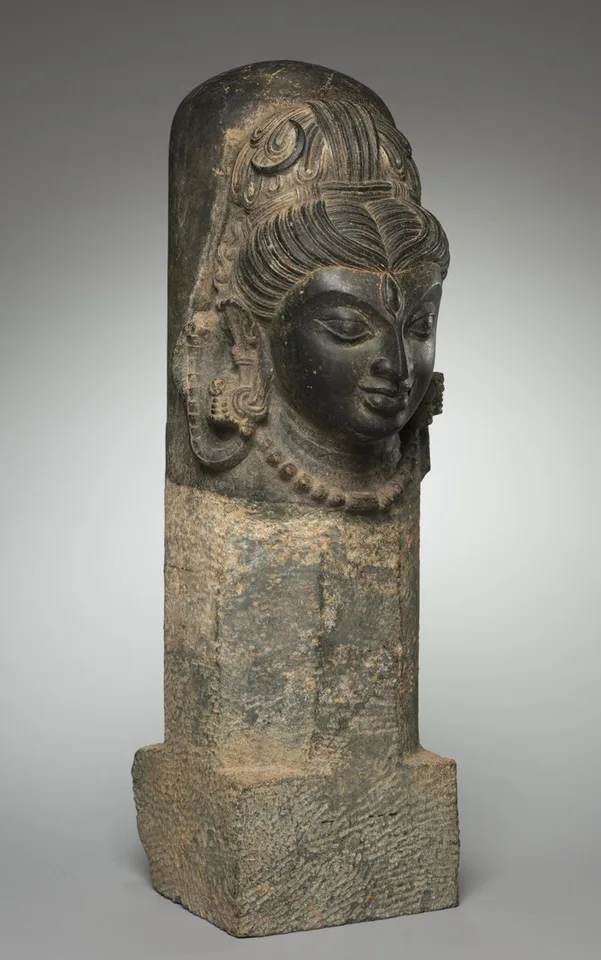
One-Faced Linga (Ekamukhalinga)

Maker unrecorded · 600s–700s

A tall dark stone form with a rounded top stands on a square base. A finely carved face projects from its upper front, framed by long hair, earrings and piled locks containing a crescent. Below the head, the shaft remains comparatively plain, with worn and mottled surfaces.
100%

Drag to move · Pinch or +/− to zoom · Arrow keys to pan · 0 to reset

The Cleveland Museum of Art · 1973.73 · Image: CC0Museum image ↗
A little context

A carefully carved face emerges from a largely plain column, making the shift from unformed potential to embodied presence visible.

The contrast between face and shaft is the work’s central event. Eyes, lips, hair and ornaments receive close attention near the top, while the lower stone remains comparatively plain. The head seems to emerge from a form that has not become a complete human body. Looking between those two kinds of carving helps explain why the object should not be treated simply as an unfinished portrait.

The museum identifies a one-faced linga associated with Shiva. A linga is a stylized phallic emblem; in the museum’s account, it and the temple’s innermost ‘womb chamber’ express the potential for creation. The emerging face marks a first stage of manifestation. It bears Shiva’s matted locks, crescent moon and third eye. Such an image would chiefly have been approached by Brahmin priests conducting worship. Removed from that setting, the sculpture still preserves the deliberate relationship between an abstract sacred form and specific divine features.

A careful reading

The object’s meaning depends on its Hindu temple context, which this isolated view cannot restore. The plain shaft is intentional and should not be mistaken for unfinished portrait carving.
Try your eye

How does the plain lower shaft contribute to the image?

Where this reading begins

  • One-Faced Linga (Ekamukhalinga) — collection record — The Cleveland Museum of Art. Supports dating, materials, attribution, provenance and the contextual reading; observations describe the individually inspected museum photograph. Museum record updated 2026-11-13; accessed 2026-11-14.

Our observations describe the supplied museum photograph. Historical identifications and context follow the cited collection record; interpretive limits are stated above. This is an independent guide, not a museum endorsement.

Image rights & attribution

One-Faced Linga (Ekamukhalinga), 600s–700s. Eastern India, Bihar, Medieval period, Pala dynasty. Chloritic schist; overall: 83.8 cm (33 in.). The Cleveland Museum of Art, John L. Severance Fund, 1973.73

Individual API record marked CC0; checked 2026-11-14. CC0 1.0 dedication. Record date: 2026-11-13 17:34:32.916000. Museum print JPEG downloaded unchanged and retained; complete overview resized and recompressed as JPEG; responsive WebP and zoom derivatives resized and recompressed; numbered annotation overlay separate from image.