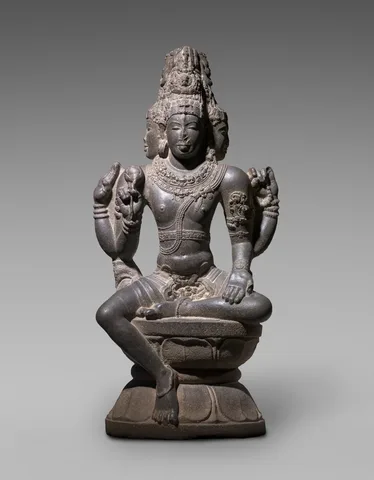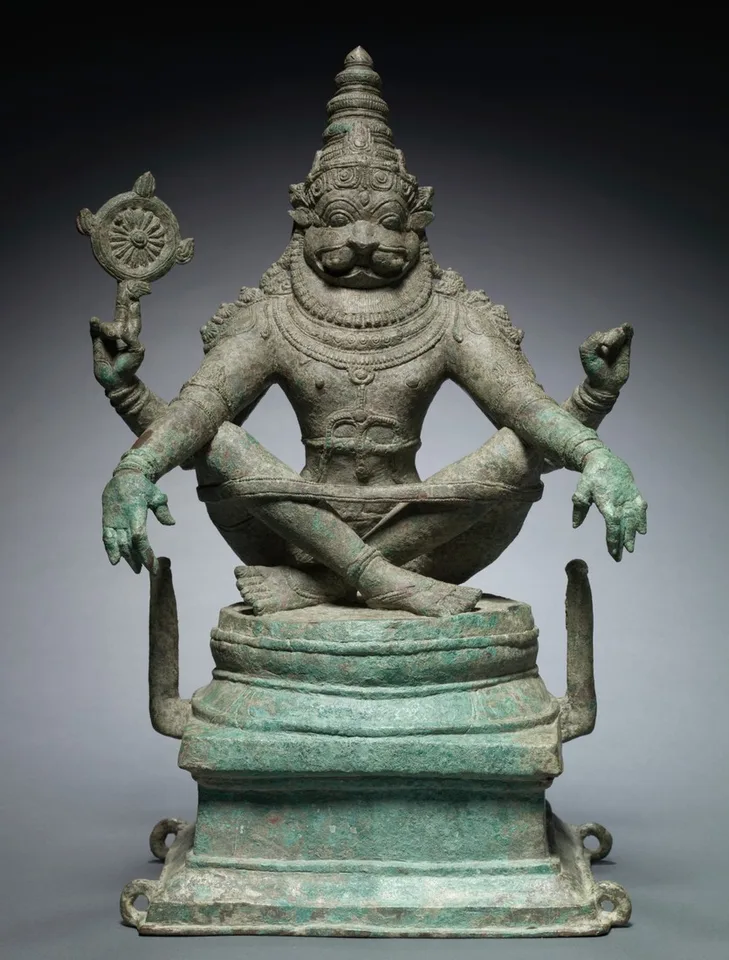
A lion face sits above crossed legs held by a yoga band, turning extraordinary power into an image of disciplined stillness.
The face announces extraordinary power, but the body concentrates it into a balanced seated pose. Crossed legs are held high by a yoga band, and the four arms spread with near symmetry. The circular discus in an upper hand and the piled crown frame the central gaze. The contrast is between force and disciplined stillness, rather than between an active body and a passive one.
The museum identifies Yoga Narasimha, Vishnu in his man-lion incarnation. The form recalls a myth of defeating a seemingly invincible enemy, yet this image emphasises royal power and yogic concentration. The flaming discus is explained as cutting through ignorance and its demonic personifications. Two posts beside the seat once supported a halo, now absent. That missing element matters: the current outline is more open than the complete image would have been, and the photograph cannot supply the original surrounding shape.
The halo is missing, and the present silhouette is incomplete. The lion face recalls a wider myth, but this sculpture depicts a specific yogic form rather than the battle itself.
Which detail most clearly makes this a yogic seated form?
Practise looking at Yoga Narashimha, Vishnu in his Man-Lion Avatar →