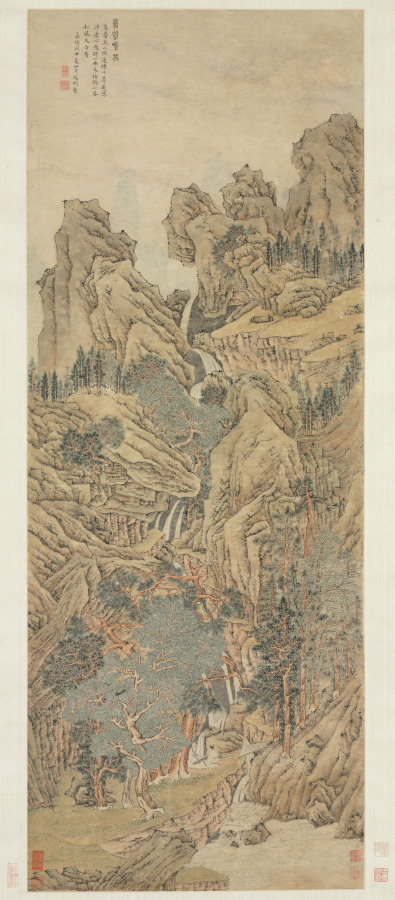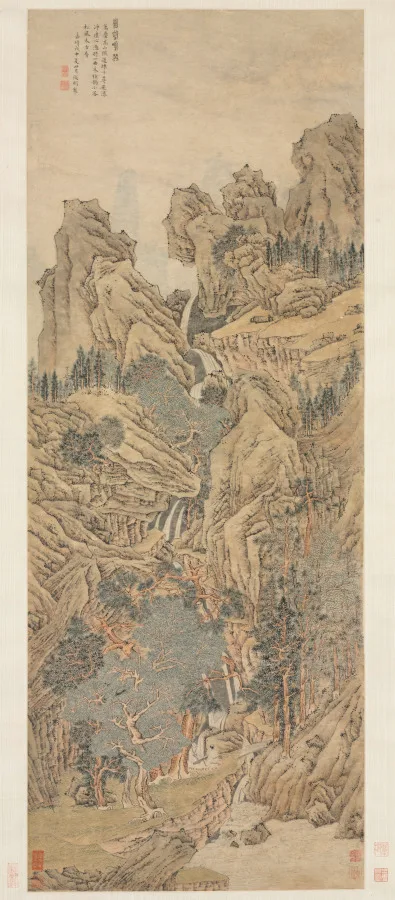
Find the tiny musician beneath the trees, then follow the falling water upward into a landscape much larger than its inhabitant.
At first, the mountains seem to be the entire subject. Then a tiny seated figure appears near the lower part of the scroll, beneath a spreading tree and beside the running water. The title identifies the activity as playing the qin, a Chinese stringed instrument. The eye can travel from this quiet human scale up the successive waterfalls and into the high rocky formations.
The poem on the painting connects music, pine wind, waterfalls, and a cultivated response to landscape. The museum explains that playing the qin in such a setting could suggest harmony between people and nature within Chinese literati culture. Attribution is more complicated than the title might imply: the current record says an imitator of Wen Zhengming, and notes scholars’ comparison with his pupil Lu Zhi. Notice the solid rock masses and carefully arranged volumes, but do not turn stylistic resemblance into certainty. The painting offers both a coherent experience of retreat and an unresolved question about authorship.
The current record attributes this work to an imitator of Wen Zhengming. A proposed connection to Lu Zhi is scholarly discussion, not a settled identification; the displayed date and authorship should be read with that qualification.