Read the
Picture
An open collection
Japan, Edo period (1615–1868) · Print

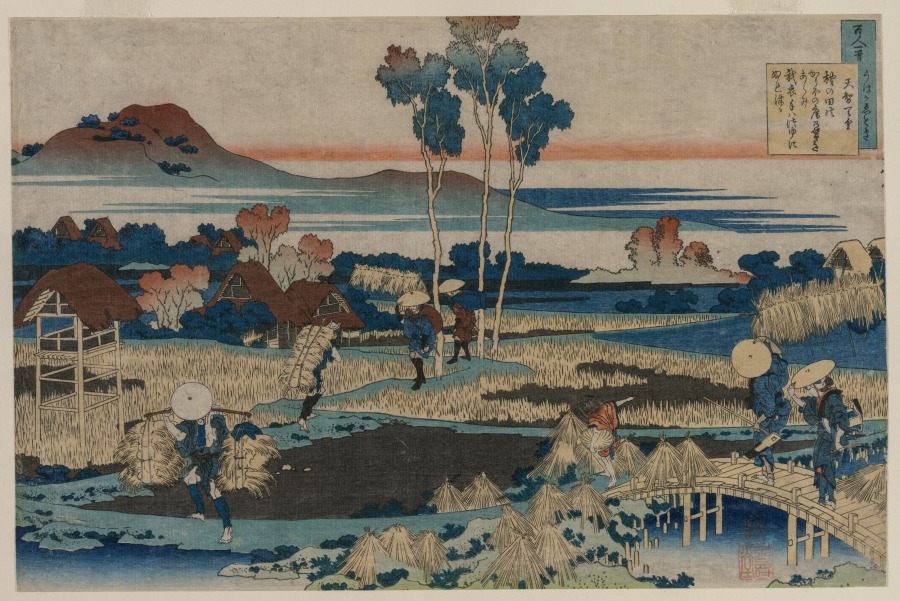
Poem by Emperor Tenchi, from the series One Hundred Poems by One Hundred Poets Explained by the Nurse

Katsushika Hokusai (Japanese, 1760–1849) · 1835–36

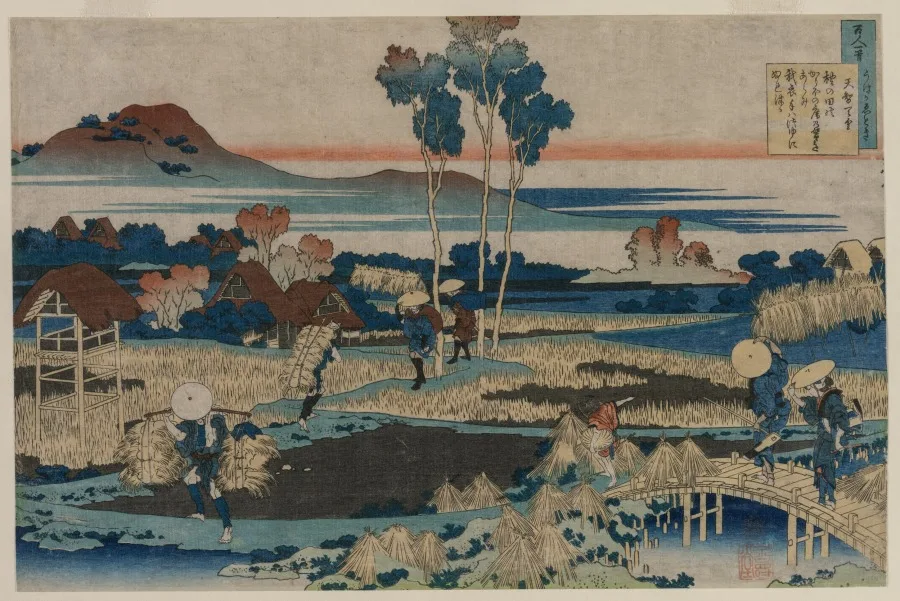
In an autumn landscape, small figures carry and gather bundles among harvested rice fields. Stacks of sheaves stand near a narrow wooden bridge at the lower right. Houses and tall trees occupy the middle distance, with blue water and low hills beyond. A rectangular block of writing appears in the upper right.
100%

Drag to move · Pinch or +/− to zoom · Arrow keys to pan · 0 to reset

The Cleveland Museum of Art · 1916.1164 · Image: CC0Museum image ↗
A little context

A classical poem meets a busy harvest landscape, where bundles, paths, and tiny figures make labour the centre of attention.

Hokusai spreads the work of harvest across the foreground: bundles are gathered, stacked, and carried along paths. The scene rewards moving slowly from one figure to the next. Repeated sheaves connect the workers’ bodies to the land, while the waterways and low hills open a quieter distance beyond their activity. The small structures and crossings help turn the field into a lived environment.

The print belongs to a series responding to the anthology One Hundred Poems by One Hundred Poets. The museum relates this design to Emperor Tenchi taking shelter in a rice farmer’s hut and feeling sympathy for the hardships of ordinary people. The poem occupies the upper right, but the image gives much of its space to the people whose work makes that sympathy meaningful. We are looking at a nineteenth-century interpretation of an older poetic tradition, not an eyewitness image of a seventh-century emperor. Text, memory, and contemporary visual storytelling share the sheet.

A careful reading

The scene is an interpretation of a classical poem and its associated story. It should not be used as direct evidence of what Emperor Tenchi actually saw, or as a complete description of every rice farmer’s life.
Try your eye

What best explains why this is more than a straightforward landscape view?

Where this reading begins

Our observations describe the supplied museum photograph. Historical identifications and context follow the cited collection record; interpretive limits are stated above. This is an independent guide, not a museum endorsement.

Image rights & attribution

Poem by Emperor Tenchi, from the series One Hundred Poems by One Hundred Poets Explained by the Nurse, 1835–36. Katsushika Hokusai (Japanese, 1760–1849). Color woodblock print; sheet: 24.4 x 37 cm (9 5/8 x 14 9/16 in.). The Cleveland Museum of Art, Gift of Mr. and Mrs. J. H. Wade, 1916.1164

Individual API record marked CC0; checked 2026-11-13. CC0 1.0 dedication. Record date: 2026-05-29 05:06:59.133000. Web JPEG downloaded unchanged; responsive WebP and zoom derivatives resized and recompressed; numbered annotation overlay separate from image.