A mountain becomes a few great shapes, yet tiny marks and the grain of a printing block keep the surface alive.
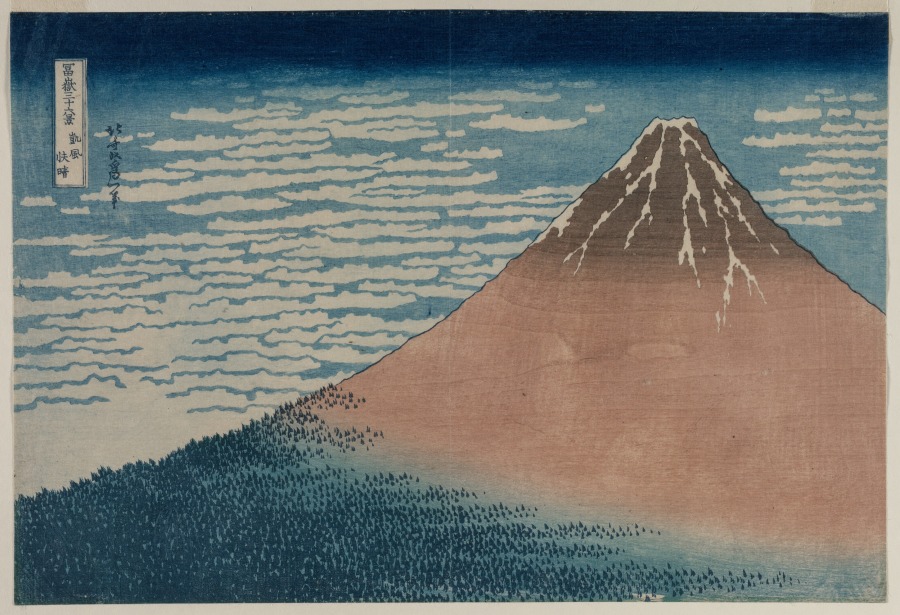
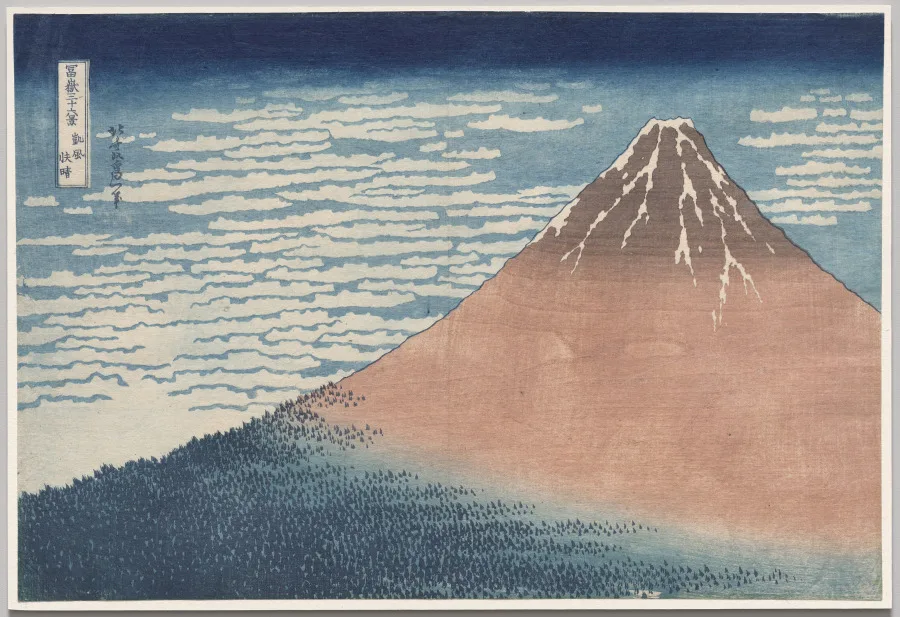
Hokusai makes Mount Fuji almost fill the sheet without placing its summit in the centre. The long slope expands toward the left, while the peak rises nearer the right edge. Below it, densely repeated tree marks create a dark foothill; above it, pale horizontal cloud bands interrupt the blue. The image’s simplicity is carefully organised rather than empty of detail.
Known as “Red Fuji,” this print belongs to Thirty-Six Views of Mount Fuji, a series exploring the mountain from many positions and in different conditions. The museum identifies the reddish appearance with late summer or early autumn. It also notes that the cherrywood block left traces of its grain in the red printing. Look closely at that mountain surface: a scene of nature also records contact between paper, colour, and carved wood. This is a printed design, not a direct photograph of one fixed moment, and impressions can differ in colour and wear.
The museum’s seasonal identification is tied to this design. Colour varies between print impressions and digital reproductions, so the precise hue on a screen should not be treated as a measured record of Fuji.
Which detail connects the image directly to how it was printed?
Practise looking at South Wind, Clear Sky, from Thirty-Six Views of Mount Fuji →