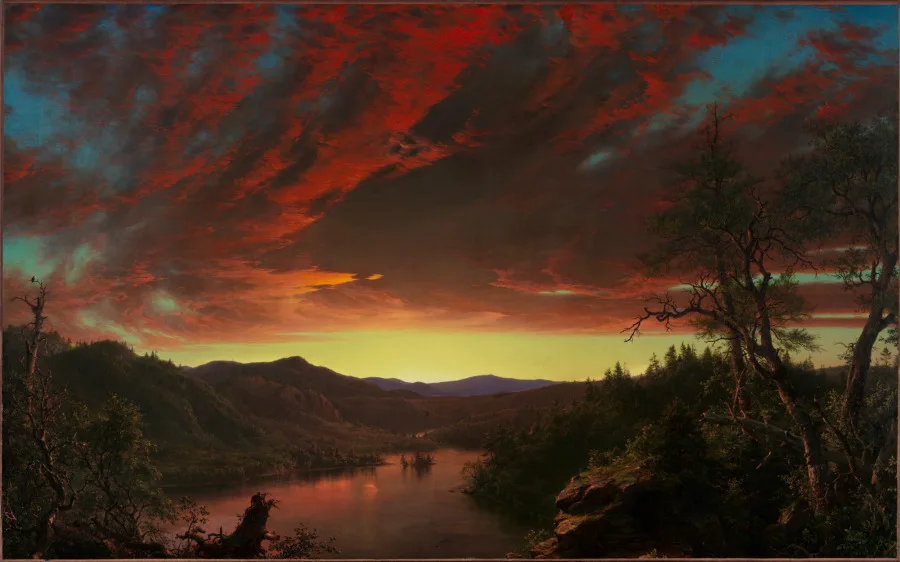
A fiery sky can invite a historical interpretation, but begin by separating what is visible from what it might suggest.
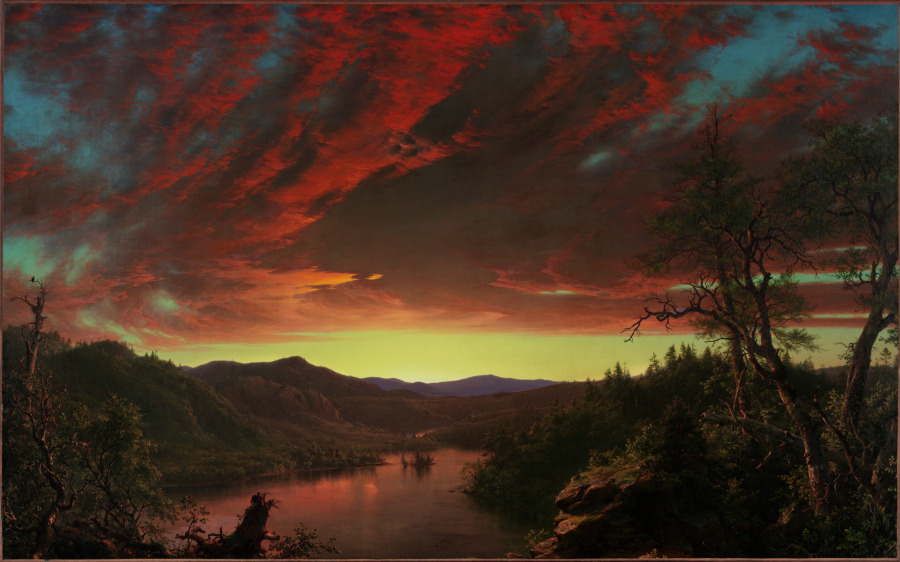
The red sky is almost theatrical, yet the lower landscape asks for slow adjustment. Dark rocks, trees, and water gradually emerge beneath the brilliant sunset. Church based the painting on scenery near Mount Katahdin in Maine that he had sketched earlier, then developed this large effect in his New York studio. The finished work is therefore a constructed landscape experience, not a picture completed in one uninterrupted outdoor moment.
Painted in 1860, shortly before the American Civil War, the sunset has been interpreted as anticipating national catastrophe. The museum presents that reading as a possibility, and it is useful to keep the qualification. Red clouds do not themselves prove a political message. What we can see is a strong contrast between intense sky and dark land, with the water carrying the glow inward. Church first exhibited the painting on its own, allowing viewers to attend to this single, carefully staged visual event.
A connection with the approaching Civil War is an interpretation, not an inscription in the scene or a settled statement of the artist’s intention. Do not equate every red sunset with war.