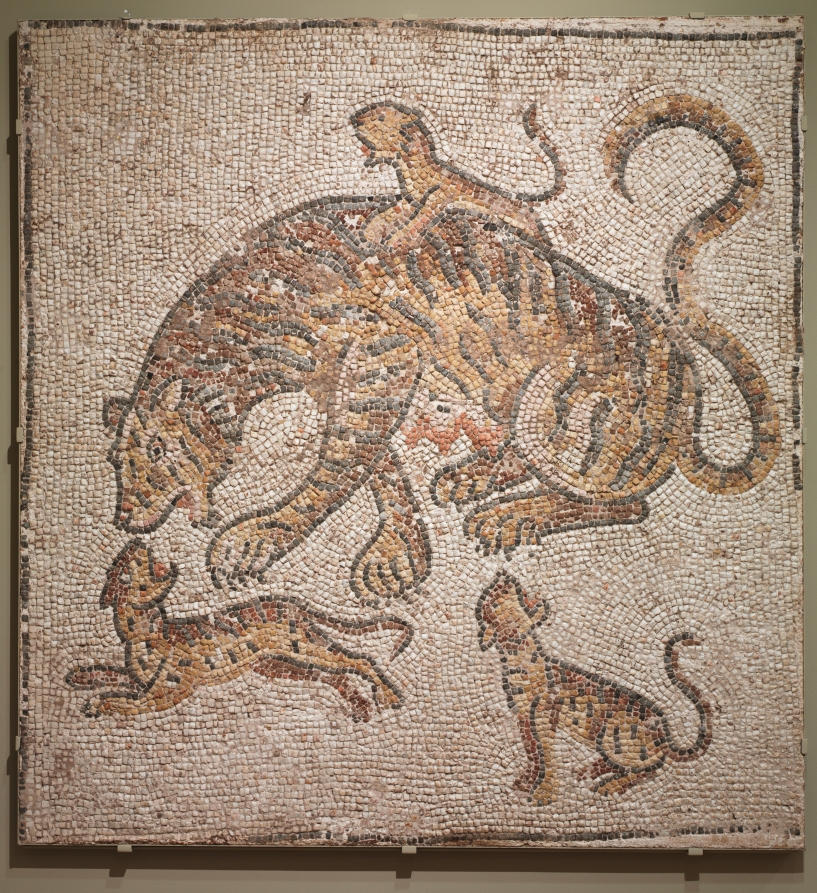
Thousands of small stone pieces create an animal family full of curves, movement and an expression we cannot quite settle.
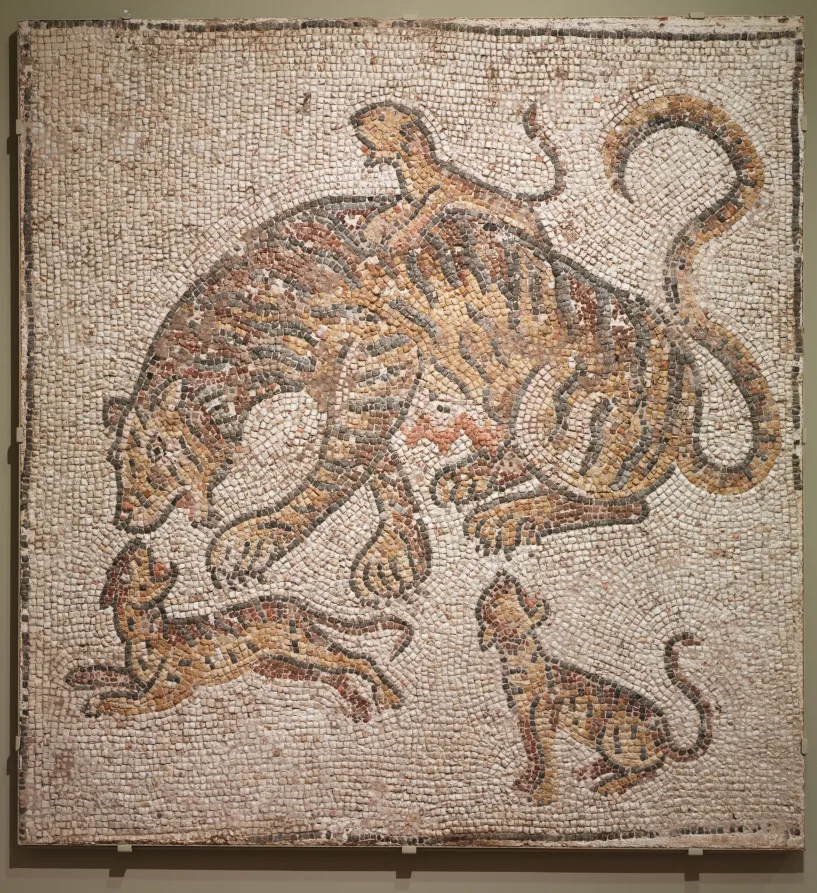
A cub rides on the tigress's back while two others occupy the ground in front of her. The mother lowers her head and extends a paw. Is she playing, correcting a cub, or responding in another way? The image gives enough action to engage our imagination, but not enough to choose one emotional explanation with certainty.
Made in the eastern Roman Empire in the fourth century CE, the mosaic constructs its lively scene from many small pieces of stone called tesserae. The museum estimates that there are more than ten thousand. Look at how rows of pieces turn around tails, backs and paws: square units do not force the picture to be angular. The striped bodies are another form of repetition, running across the much smaller repeated stones. Tigers are less common in Roman imagery than some other large animals, according to the collection record, making the choice of a tigress with cubs especially worth noticing.
The museum leaves the tigress’s action open to interpretation: play and scolding are both possibilities. A human viewer’s emotional reading should not be presented as certain animal behavior or as the maker’s documented intention.