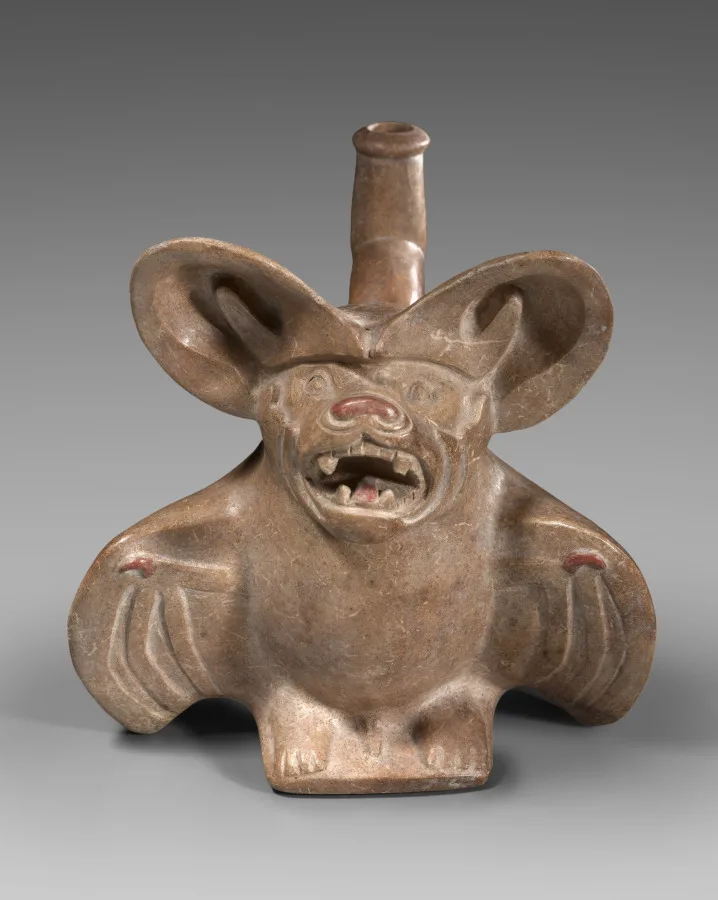
Oversized ears, an open mouth and folded wing supports make this vessel both an attentive animal study and a usable container.
The enormous ears are the first clue, but keep looking at the wings. They are not feathered surfaces: long supports divide the membrane-like forms beside the body. An open mouth exposes teeth, and a narrow spout rises behind the head. The maker has combined a convincing set of animal traits with the demands of a hollow container.
The vessel was made by Moche people on the north coast of the central Andes. The museum connects its close observation to a big-eared brown bat species described by researchers in 2021 and named Histiotus mochica in reference to the Moche. Its religious significance is less certain. The collection record suggests that bats' unusual combinations of traits may have linked them to transitions, including between life and death. That is a contextual possibility rather than something proven by the ears or teeth. The strongest starting point remains the careful attention to how this animal's body is put together.
The museum’s proposed connection between bats and transitional states is speculative. A modern species identification and name do not establish the exact meanings assigned to this vessel. The museum also marks its pre-acquisition history as awaiting an update.