Follow a lotus upward from a reclining god to see how a painting makes the beginning of a world visible.
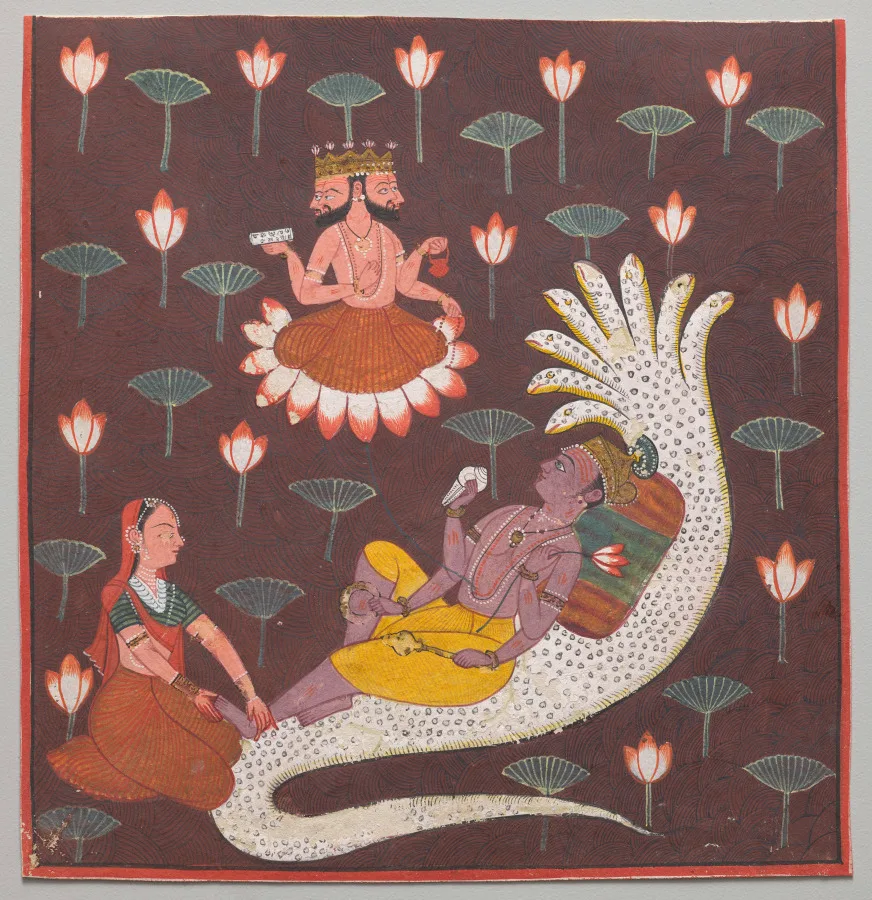
The scene looks quiet, but it concerns the beginning of a world. Vishnu rests on the endless serpent Ananta, whose body curves into a couch and whose multiple heads rise behind the god. At his feet sits Lakshmi. The museum explains that her gentle massage awakens Vishnu when the time for creation arrives; from his navel a lotus emerges, carrying Brahma, the creator deity.
Instead of painting a naturalistic sea, the artist fills the background with evenly spaced flowers and leaves. The cosmic ocean becomes a lotus pond, a familiar form used to picture an immense religious idea. Trace the large white curve of Ananta, then the connection to the flower above: the composition joins rest, awakening, and creation within one view. Painted around 1700 in the Pahari region of northern India, this is one local pictorial treatment of a Hindu narrative, not an illustration of a belief shared identically by all Hindu communities.
The identification of the figures follows the museum’s account of this work. Lotus imagery, body colour, and multiple heads acquire meaning within this narrative; they should not be treated as universal symbols.