Made to be seen
Display can belong to a small object, an entire room, a person’s portrait, or a public spectacle. These works make different claims on a viewer through reflective surfaces, decorative structure, elegant clothing, and forceful bodies. Move between things intended for use and images of people being seen, keeping the designer, maker, sitter, performer, and audience distinct rather than treating visibility as a single kind of social power.
Begin the journey ↓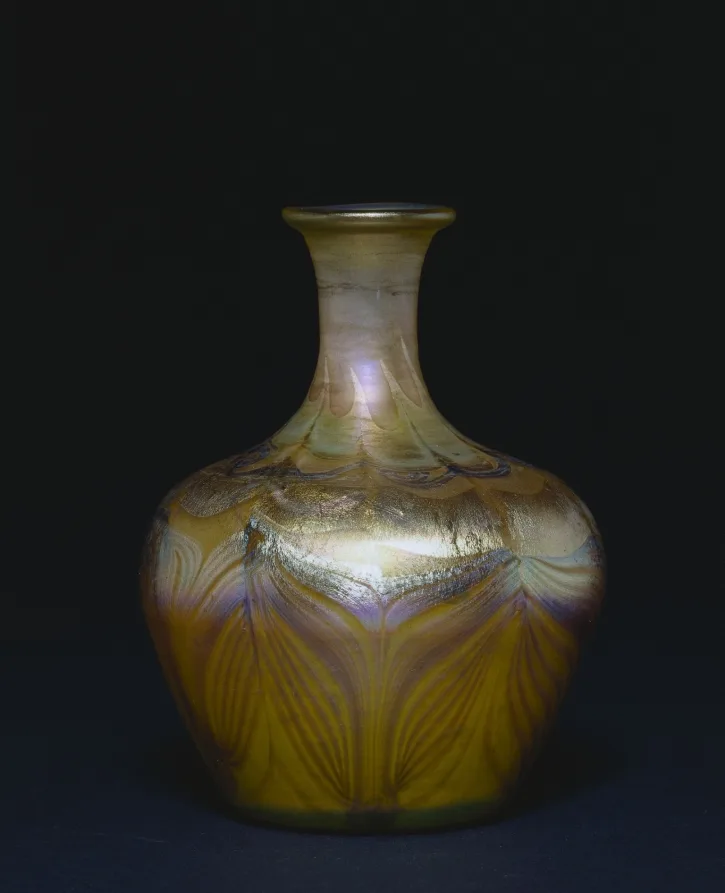

A surface that catches attention
The rounded glass shoulder changes color under the photograph’s light. The museum connects Favrile glass with collaborative production, exhibitions, and marketing. Begin with the visible effect, then keep Tiffany’s design role separate from the studio’s making: a famous name does not account for every participant in an object’s production.
Carry this question: How does the curved surface shape where the brightest color appears?
Open the artwork ↗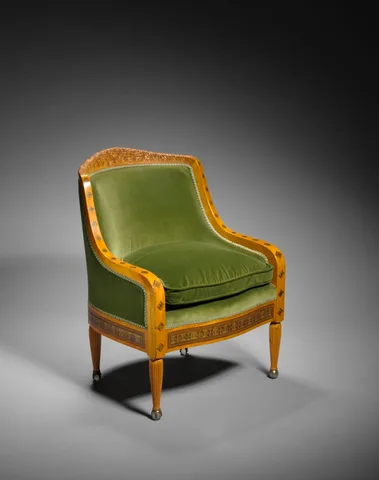
Decoration follows use
The chair carries ornament along the arms and frame a sitter would encounter physically. Its curved structure and small inlays coordinate use with visual enrichment. The museum places it within Tiffany’s broader interior design practice, extending the previous vase’s concern with display into an object organized around a seated body.
Carry this question: Where does ornament follow a part of the chair used by the body?
Open the artwork ↗
Clothing becomes a major surface
Sargent’s satin dress occupies much of the portrait and reflects light in carefully varied passages. Lisa Colt Curtis remains a person with an outward gaze, while the full-length format and furnished setting communicate social position. Material display and individual presence operate together rather than being interchangeable.
Carry this question: How does the dress lead your eye back toward the sitter’s face?
Open the artwork ↗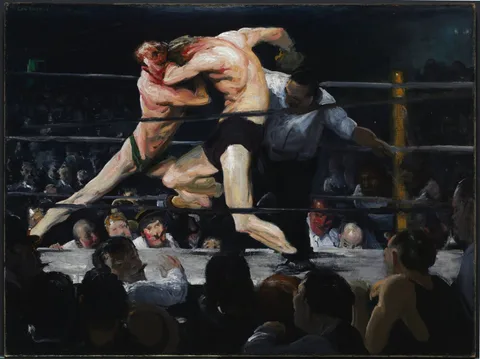
Include the people watching
The boxers dominate the ring, but faces crowd along its edge. Bellows makes an audience part of the scene, unlike the implied viewers of the vase or portrait. The museum’s account of private club bouts explains how the spectacle was organized and why the title uses the word stag.
Carry this question: How does the close crowd change the effect of the fighters’ collision?
Open the artwork ↗Look at a pair more closely
- A surface and its painted image
Tiffany’s Favrile vase and Chardin’s pantry shelf
Read with the sources
Historical context follows the individual museum records linked on each artwork page. These routes make original comparisons of visible form; resemblance alone is not evidence of shared meaning or direct influence.