Color seems to move across the glass, while the designer’s name and the studio’s making point to different kinds of work.
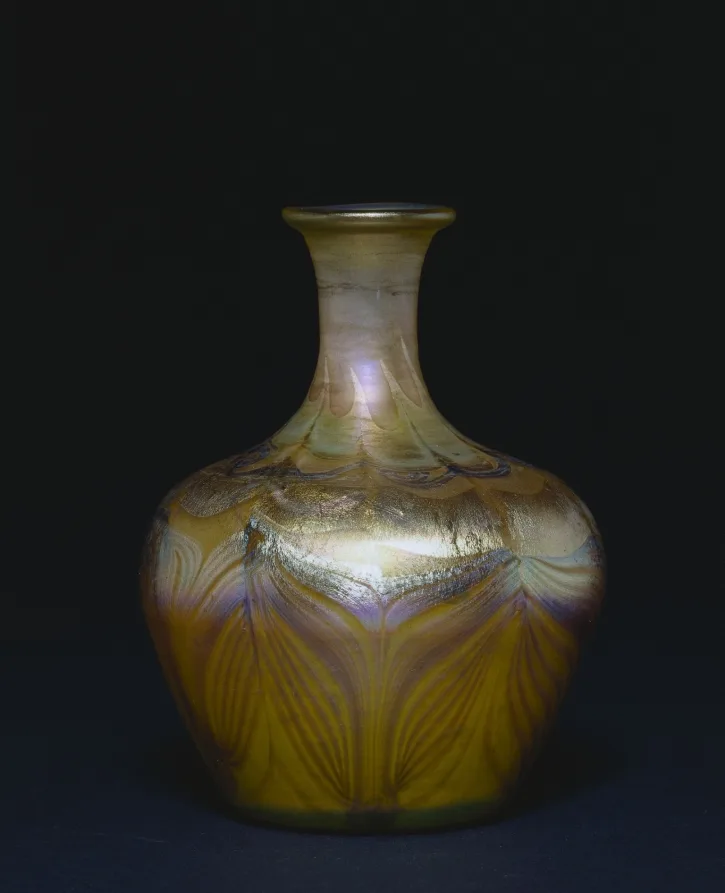
The vase’s shape is simple enough to grasp quickly: a rounded body narrows into a long neck before opening at the rim. Its surface is less stable. Gold, green, violet, and pale metallic-looking highlights change across the curve, while repeated featherlike lines draw the eye upward. The photograph’s dark background makes those shifts especially conspicuous.
The museum identifies the material as Favrile glass, developed through Louis Comfort Tiffany’s collaboration with glass workers and promoted through exhibitions and retail display. It credits Tiffany as designer and Tiffany Studios as maker. Those roles help prevent a celebrated name from obscuring the collaborative conditions of production. The museum also describes the product name’s marketing ambitions, joining artistic effect with commercial presentation. Compare the broad luminous shoulder with the narrow neck: the same material behaves differently across changing curvature, making this small vessel an exercise in shape, surface, and the managed encounter between object and light.
Keep the designer and studio-maker roles distinct. The photographed colors depend partly on lighting and viewing angle; a single reproduction cannot show every appearance of the glass or identify the contribution of each individual workshop participant.